
5 Reasons Curved Staircases Add the Most Value to a Luxury Home

There is a version of this conversation that stops at aesthetics. Yes, curved staircases look impressive. Yes, people notice them. But if you are making a significant investment in a bespoke staircase design, the question worth asking is: what does it actually do for the value of your home? Not just how it feels to stand in front of one, but what effect it has in real terms, on resale price, on how buyers perceive a property, and on the overall quality of life inside it.
Your stairs may not add value in an obvious, measurable way. But a curved staircase, done well, is one of the few architectural features that genuinely can. Here are the five reasons why.
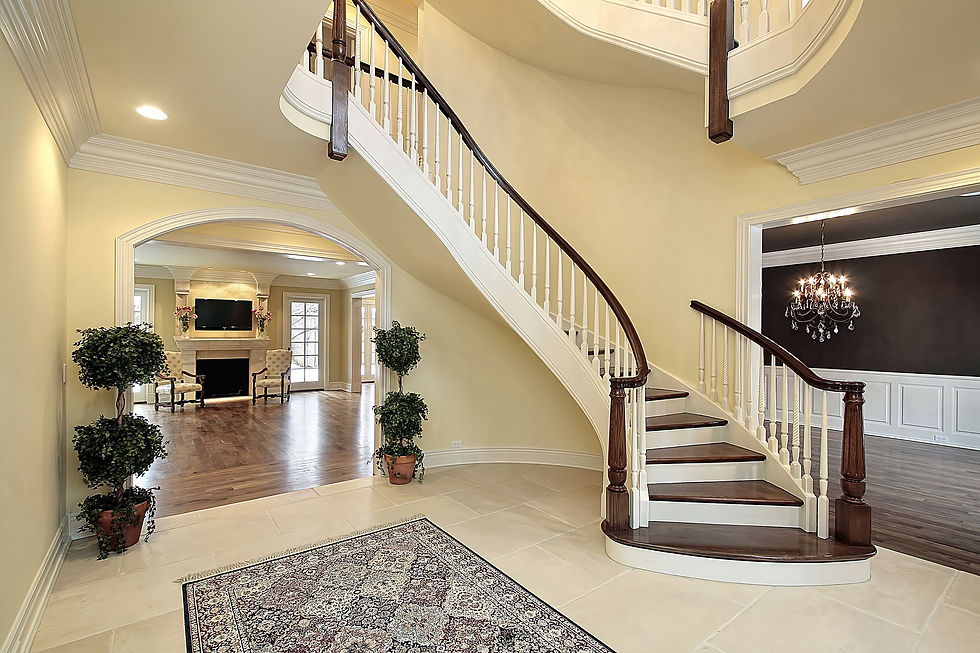
Reason 1: It Creates a Grand Entrance That Sets the Tone for the Whole Property
There is something that happens when you walk into a house and the first thing you see is a well-designed curved staircase sweeping upward through a double-height space. It sets an immediate register. Even before you have assessed the kitchen or the bedrooms, you have already formed an impression of the property, and it is a positive one.
A curved staircase can really provide that quality of first impression that is otherwise very hard to manufacture. You cannot fake it with furniture or paint. It either exists in the architecture or it does not.
Why This Matters for Valuation
Estate agents and buyers frequently describe the hallway and entrance as the most important spaces for setting perceived value. A staircase that commands attention in that space does not just look good; it signals investment, quality, and considered design throughout. Buyers begin to assume that the same attention to detail exists in every other room, even before they have seen them.
This is particularly true in the premium end of the market, where buyers are not just purchasing square footage. They are purchasing a feeling.
Reason 2: Curved Staircases Make a Space Feel Larger and More Open
Straight staircases, particularly in tighter hallways, can feel like a structural intrusion. They cut across a space, interrupt the sight lines, and often close off what could otherwise be a more generous room. Curved staircases work differently.
Curved staircases can make a room feel more open and airy in a way that is genuinely hard to replicate with other staircase designs. The sweeping arc draws the eye upward rather than across, which creates an impression of height and volume. Combined with open risers or a glass balustrade, the effect can be quite transformative, particularly in homes where the entrance hall is not especially large.
The Light Argument
One thing people perhaps underestimate is how much natural light a well-positioned curved stair can bring into a space. Without the solid wall of a traditional closed-string staircase blocking it, light can travel through and around the structure more freely. Wood and glass combinations are especially effective here. The result feels lighter, more spacious, and considerably more modern without needing to change anything else about the room.
Reason 3: The Aesthetic Appeal Goes Beyond Trends
There is a category of staircase design that is very clearly of its moment. Floating staircases with black steel and minimal treads look sharp right now. They suited the interiors of 2018 as well, and they will probably look slightly dated by 2030. That is not a criticism; it is just how design cycles work.
Curved staircases sit in a different category. The shape itself, that continuous sweep from ground to upper floor, has been considered beautiful for centuries. It does not age in the way that more modular or industrially styled staircase designs tend to. A bespoke curved stair in solid wood, with considered handrail detail, will look as considered in twenty years as it does today.
Material Choices That Hold Their Value
The materials used in a curved stair also contribute significantly to its long-term appeal. Some combinations that hold well over time:
Oak or walnut treads with a natural or lightly brushed finish
Painted timber with integrated glass panels for a blend of warmth and light
Wrought or powder-coated metalwork used sparingly as a structural element rather than a decorative one
Each of these choices reads as considered rather than trend-driven, which matters a great deal in the luxury market.
Reason 4: They Signal Quality That Buyers Recognise Immediately
Not every improvement to a house is visible. A new boiler adds real value, but buyers do not experience it emotionally. The same is true for better insulation, upgraded wiring, or a more efficient heating system. These things matter, but they do not generate feeling in the way that a well-crafted architectural feature does.
A bespoke curved staircase is visible, physical proof of serious investment in the property. It is not a finish that was applied quickly or sourced from a catalogue. Custom curved staircase projects involve real craftsmanship, specialist manufacturing, and considered design decisions at every stage. Buyers who understand quality can see that instantly.
This is worth thinking about in terms of how it positions a property in the market. A house with a genuinely impressive curved stair will be remembered. It becomes part of how that property is described, by agents, by viewers, and by the eventual buyer when they tell someone about it.
A Note on Functionality
It is worth acknowledging that curved staircases are also, simply, more pleasant to use. The tread depth across the full walking line is more generous than on a compact spiral staircase. The going feels more natural. Day to day, this is the kind of functionality that people notice without necessarily being able to say why.
Reason 5: The Investment Case Is Stronger Than Most Homeowners Expect
Yes, a bespoke curved staircase costs more than a standard flight. That is not a secret, and it is not a reason to avoid them; it is simply a factor to understand properly. The more useful question is whether the investment returns more than it costs, and in the luxury residential market, the evidence tends to suggest it does.
Curved staircases are great focal points in high-value homes, and buyers in this segment routinely factor design quality into their offers. A property that already has a standout architectural feature is perceived as requiring less work, less investment, and less decision-making. There is direct cash value in that.
It is also worth considering what your stairs may not add to a property if they are purely functional. A basic closed-string staircase does the job, but it does not generate interest, attention, or the sense of considered design that moves luxury buyers emotionally.
Summary: Curved Staircase Value at a Glance
Value Factor | How a Curved Staircase Delivers |
First impressions | Creates an immediate grand entrance in entry spaces |
Space perception | Opens up rooms, improves sight lines and natural light |
Design longevity | Classic form that does not date with short-term trends |
Perceived quality | Physical signal of serious investment and skilled craftsmanship |
Resale and market appeal | Memorable feature that supports premium pricing |
FAQs
Do curved staircases actually increase the value of a home?
In the luxury and premium residential market, yes, they consistently do. Buyers in this segment place significant weight on design quality, and a bespoke curved staircase signals craftsmanship and investment in a way that most other features cannot. While the uplift is difficult to measure in precise terms, estate agents working in higher-value properties regularly report that standout architectural features, staircases in particular, contribute to stronger offers and faster sales. The key factor is quality: a well-designed, properly crafted staircase adds value in a way that a basic installation simply does not.
Are curved staircases only suitable for large homes?
Not necessarily. While a full helical staircase with a wide-open void typically requires a generous floor opening, curved stair designs can be adapted to suit a range of properties. The plan geometry, inner radius, and overall footprint can all be adjusted during the design phase. Smaller curved configurations, or those with a tighter arc, can work well even when space is limited. The most important thing is to involve a specialist early in the planning process, before structural decisions are fixed, so the design can respond properly to what the space allows.
What materials work best in a modern curved staircase?
The most successful material combinations in modern curved staircase projects tend to balance warmth with visual openness. Solid wood treads, particularly oak or walnut, paired with glass panels and a continuous curved handrail, remain the most consistently well-received choice. The wood adds texture and warmth; the glass keeps the stair feeling light and airy. Metal detailing, used carefully in structural or support elements rather than as a dominant visual feature, also works well. The specific finish and species should ideally be chosen to complement the wider interior rather than as a standalone decision.
How long does a custom curved staircase take to design and install?
Timelines vary depending on the complexity of the design, the materials involved, and whether the project is part of a new build or a renovation. As a general guide, the full process from initial consultation through to completed installation typically takes several months for a bespoke curved staircase. This covers design development, structural survey, manufacturing, and the installation itself. Projects that involve significant custom work, unusual plan geometries, or integration with existing period architecture may take longer. Engaging a manufacturer like Bavari at the earliest stage of a project helps to avoid programme delays later on.
Ready to Commission a Curved Staircase for Your Home?
Bavari designs and manufactures bespoke curved staircases for residential and commercial properties across Ireland and the United Kingdom. Whether your project is at the planning stage or already underway, get in touch to begin your design consultation or browse Bavari's portfolio of completed staircase projects.


Comments